
From the blog
A Search Console for ChatGPT? What businesses should do now
Back in 2015 I wrote about Google adding impressions and click data to its Webmaster tools. Eleven years later, there's a familiar-looking story doing the rounds. This time it's ChatGPT.
OpenAI appears to be working on a way for businesses to see how often they appear in ChatGPT answers, and whether anyone clicks through afterwards. Personally, I think that could be useful. It's difficult to improve something when most of your information amounts to asking a chatbot whether it likes your business.
Before anyone starts selling you a “ChatGPT Search Console setup” package, though, we need to separate what's been spotted from what's actually available.
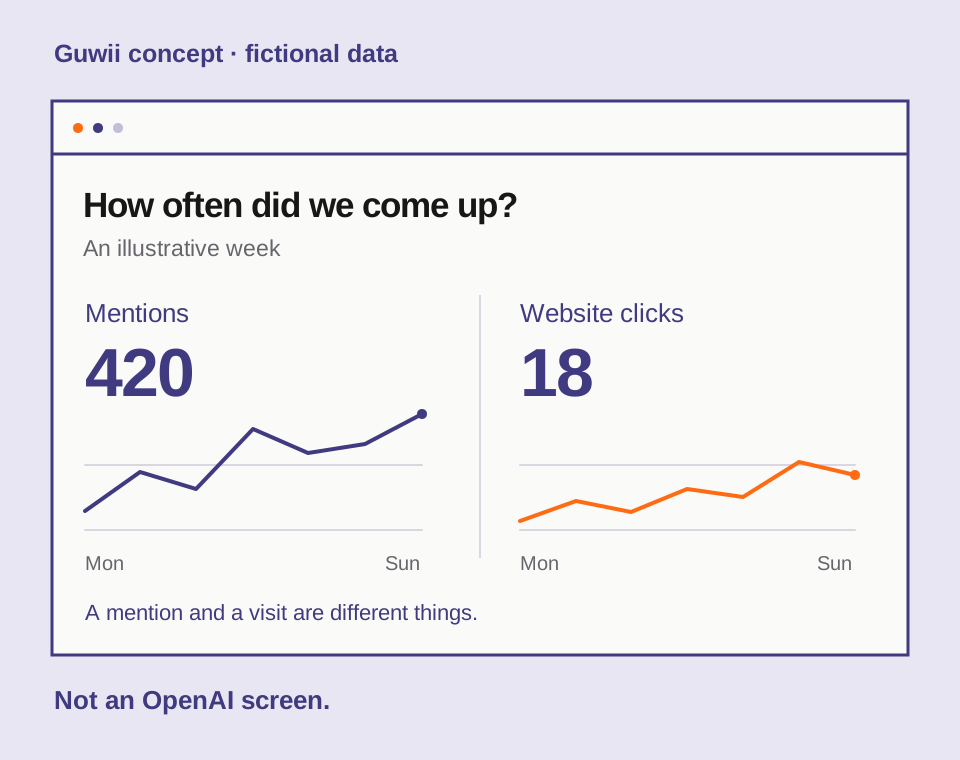
As of 6 November 2026, this is a reported feature in development. I haven't found a public OpenAI launch announcement for this business analytics hub, a general sign-up process or confirmed eligibility for service businesses. The illustrations below are my own concepts, not OpenAI screenshots.
What has actually been spotted?
Barry Schwartz's report at Search Engine Roundtable points to a LinkedIn post from Juozas Kaziukėnas. The reported interface invites businesses to claim their business in ChatGPT, within a wider Business Hub.
Kaziukėnas describes daily impressions—appearances in ChatGPT responses—and clicks to the business's website. The shared screenshot shows the claiming screen, not those charts. Its banner also refers to maintaining business and product information, and a business agent that could answer questions using information supplied by the business.
The account describes ownership verification, with connecting a Shopify store given as an example. It does not establish that every business, country or website platform will qualify. There's no reported prompt-level data, customer data or competitor ranking in the view described.
State of AI and PPC Land covered the same sighting on 6 November. That's useful discussion, but several articles repeating one discovery don't turn it into several independent confirmations.
“Search Console for ChatGPT” is a handy comparison. It isn't a confirmed product name. This also shouldn't be confused with the ChatGPT Business workplace subscription, or with paying for ChatGPT ads.
A window onto the recommendations you never see
Imagine someone asks for a web developer while chatting to a friend in a café. Your name comes up, they remember it, and a week later they look you up. You got a recommendation, but your website analytics can't see that conversation.
AI discovery can have a similar gap. Someone might see your business in an answer, compare you with a couple of alternatives, then visit later. A referral report only tells you about the visits it can identify.
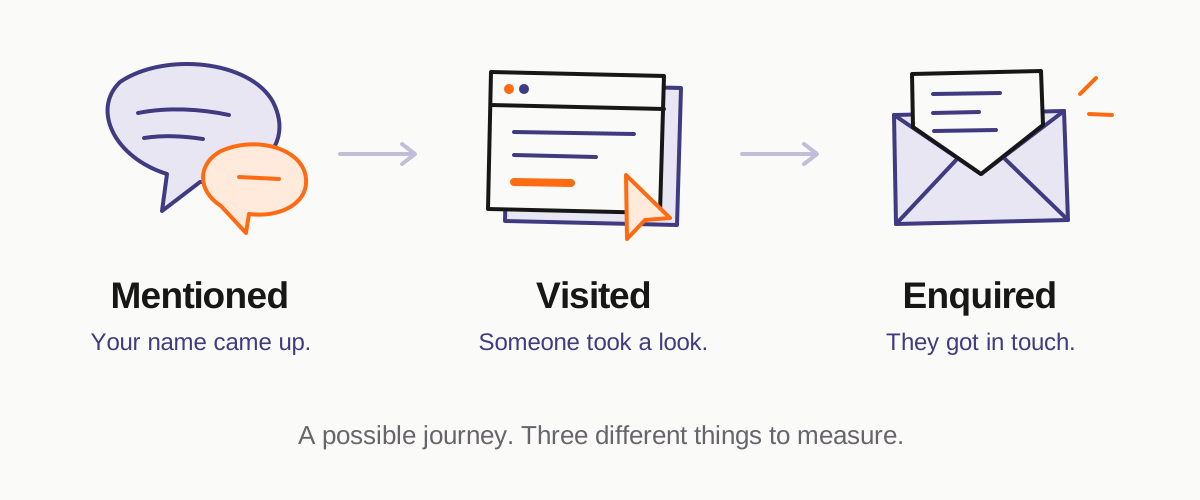
If OpenAI makes its own visibility data available, businesses could get a better view of that earlier part of the journey. Being mentioned, being recommended and winning the work are still different things. A mention might even be inaccurate or unhelpful; a rising chart alone won't tell you.
For a small business, I'd want to know whether people are being given the right impression of what I do. For an agency, I'd want evidence that the work we're doing for a client is helping the right customers find them. Both are more useful questions than “can we make this graph go up?”
Useful numbers, with some fairly big gaps
The missing prompt data matters. If mentions fall, was there less interest in the service, a change in the answers, or a problem with the information being used? The reported dashboard wouldn't, by itself, answer that.
We also don't yet know the precise counting rules, coverage, reporting delay, export options or agency access arrangements. I'd wait for those definitions before comparing two businesses or putting a new metric into a client contract.
Even click tracking needs a bit of care. In October, Search Engine Land reported that missing ChatGPT tracking tags were a bug, with a fix rolling out. A sudden drop in attributed visits can be a measurement problem rather than lost interest. I wouldn't label every unexplained direct visit “AI traffic” either.
My preference would be a simple report with separate lines for visibility, identifiable visits and genuine enquiries or sales. Add “How did you hear about us?” to the conversation where it makes sense. It won't give perfect attribution, but it can explain things another chart won't.
What I'd get ready now
Most of the worthwhile preparation is work your website should benefit from anyway. It doesn't depend on this particular tool launching.
Give your business a clear, public brief
If you were introducing a new colleague to the business, you wouldn't hand them three out-of-date brochures and expect them to work out which one was right. Yet that's often what a website, directory listing and social profile collectively amount to.
Make it easy to establish what you offer, who it's for, where you work and how someone gets started. Explain what is included, what isn't, and any genuine starting prices or constraints. Keep the important details consistent across your own site and the profiles you control.
For a service business, “we deliver innovative solutions” doesn't help much. “We build booking systems for independent activity providers, and support them after launch” gives a prospective customer something they can actually assess. Use your real specialisms, of course; don't invent a niche just because it sounds searchable.
Check that the right crawlers can reach it
OpenAI's crawler documentation separates OAI-SearchBot, used for search, from GPTBot, used for potential model training. You can allow search discovery while declining training access. They aren't one all-or-nothing setting.
Have your developer check the actual public pages, robots rules and hosting or firewall restrictions. A friendly robots.txt file won't help if the server is challenging or blocking the requests. Allowing access makes discovery possible; it doesn't promise a citation or recommendation.
Important service information should also be readable on the page, with sensible links between related content. Don't make a visitor—or a crawler—decipher an image to learn what you sell.
Make the evidence better than the adjectives
I'd put time into a few clear case studies before generating another fifty vague blog posts. Explain what the client needed, the decisions you made and what you delivered. Show an outcome you can support, rather than adding an impressive percentage because the layout has a space for one.
Genuine reviews, named authors and accurate business profiles can help people assess you too. Respect client permissions and NDAs. An “AI visibility” project isn't a reason to publish work you aren't allowed to show.
Structured data can describe the visible business, service, product or article information more consistently. It isn't a secret instruction to recommend you. Google's current guidance for generative AI search explicitly says there is no special schema required, and that Google Search ignores llms.txt files. That's Google's guidance, not a statement about every AI system—but it's a good reason to be suspicious of anyone selling a magic file as the whole solution.
If you sell products, tidy the catalogue
Product discovery already has its own routes. OpenAI's guidance for Shopify merchants directs businesses to Shopify's Agentic Storefronts information for eligibility, catalogue access and settings. That existing route is separate from today's reported analytics feature.
Check descriptions, variants, stock, prices, delivery information and returns. A beautifully presented product with the wrong availability is still the wrong answer. Use the official route for your platform; don't assume a new dashboard will fix the source data for you.
Where agencies can actually be useful
I can already imagine the temptation to stick “GEO” or “AEO” on an existing report and call it a new service. Those labels usually mean optimising for generative or answer engines. The acronym matters less than what the client gets for their money.
I'd make the work quite concrete:
- Establish a baseline. Record current business information, identifiable AI referrals and a small set of realistic customer questions. If you sample answers, save the date, tool and context. A handful of prompts is a spot-check, not a market-wide ranking.
- Fix the actual gaps. That might mean unclear services, stale product details, blocked pages, weak case studies or an awkward enquiry form. Give each change an owner.
- Prepare access properly. Keep business accounts under the client's ownership. Use delegated access where a platform supports it. If this hub launches, verify availability and permissions through OpenAI's official channels before connecting anything.
- Report the work and the result separately. “We corrected these pages” is a fact. “Those corrections caused more mentions” needs evidence. Note tracking changes, seasonality and other campaigns before claiming credit.
The business-agent part of this reported hub could become more interesting, if it ships in this form. I'd treat that like briefing someone new on the front desk: give them approved information, clear boundaries and a way to hand over to a person. Start with ordinary questions. Don't hand over authority to invent prices, promise availability or agree refunds just because the answers sound confident.
None of that requires guessing an unreleased API or buying another subscription today. It does require understanding the business well enough to improve what customers find.
Don't wait for a dashboard to fix the shop window
I'm interested in this because first-party reporting could replace some of the guesswork. I'd still want to see the finished product, its definitions and who can use it before making promises to clients.
In the meantime, get the basics into good shape: accurate information, accessible pages, convincing examples of your work and a straightforward way to enquire. Those improvements are useful whether someone finds you through Google, ChatGPT or a recommendation from a friend.
If you'd like a hand working out what needs attention on your own site, send me a message. I can help with the content, design and technical work together—without promising a ranking that nobody can guarantee.
Keep exploring